- The Digital Bridge with Lawrence Eta
- Posts
- AI Governance Has Entered Its Most Defining Phase Yet
AI Governance Has Entered Its Most Defining Phase Yet
Tech News, Global Digital Transformation, Thought Leadership and Current Trends

Lawrence Eta
December 08, 2025

The global AI landscape is shifting, fast. Over the last year, governance moved from being a theoretical debate to a concrete strategic imperative. What we’re seeing now is not just an acceleration in AI adoption, but a parallel and urgent acceleration in the world’s attempt to govern it.
Nations are building bilateral governance partnerships. Global bodies like UNESCO are pushing for ethics that don’t just sound good on paper but can be operationalised in policy, procurement, and model life cycles. Industry players are building governance platforms that promise auditable AI at scale. And in the middle of all of this, organisations, across Africa, Europe, the Middle East, Asia, and the Americas are trying to catch up with the speed of change.
The truth is this: AI governance is no longer a compliance conversation. It is a capability conversation.
It determines whether countries protect their citizens, whether organisations innovate safely, and whether global ecosystems can actually work together without fragmenting into incompatible AI zones.
But here’s the part that often goes unspoken:
Governance isn’t slowing innovation: it’s becoming the only way to scale it responsibly.
This week’s stories show a world stepping into the practical era of AI governance. We’re finally seeing the bridge between “principles” and “practices” emerge, and who builds that bridge fastest will define the next decade of technological leadership.
This week’s edition covers:
UK-South Africa AI policy cooperation & capacity-building initiatives (University World News, 6 Dec 2025)
UNESCO’s push to turn ethical principles into operational systems (UNESCO, 5 Dec 2025)
The G20’s drive toward global coordination & interoperable governance (CSO Online & BizTech Magazine, 5-6 Dec 2025)
IBM’s watsonx and the rise of platform-based AI governance (CSO Online, 5 Dec 2025)
Bonus Insight: Why the governance capacity gap is now a strategic risk (Atlantic Council, 2 Dec 2025)
NEW GOVERNANCE BLUEPRINT
Cross Border Capacity: UK-South Africa’s New Governance Blueprint

Image Source: LSE
The deepened UK–South Africa cooperation marks one of the most meaningful bilateral governance developments of the year. Beyond symbolism, it creates practical outcomes: specialised training, policy capability building, and technical upskilling.
This matters because governance isn’t only about frameworks, it’s about people who can interpret, implement, and enforce them. If countries lack capacity, even the best AI strategies collapse on contact with reality.
This partnership is increasingly seen as a model for Global North–Global South cooperation. Unlike many governance efforts driven solely from the West, this program recognises:
policy co-creation instead of policy importation
skills transfer instead of dependency
dual-region capacity building rather than one-directional advice
It acknowledges that AI governance only works when both sides have the expertise to implement and enforce it, and that regional context matters as much as global standards.
Governance is a capacity challenge before it is a regulatory challenge. Joint programs build talent pipelines that can interpret global principles and make them work for local economies.
The countries that invest in policy talent, technical assessors, and governance architects will become the ones that shape global norms.
Real capability is built through long-term fellowships, secondments, and embedded learning, not short workshops. If governance is a national priority, talent pipelines must reflect that.
Cross-border cooperation is no longer symbolic: it’s becoming the backbone of global AI stability, and Africa is earning a seat at the governance table, not just receiving instructions from it. Cross-border partnerships are quietly becoming the backbone of global AI stability, and the countries that invest early will set the standards others follow.
UNESCO: FROM MANIFESTO TO MECHANISM
UNESCO’s Ethical Anchoring: Beyond Principles, Into Practice

Image Source: UNESCO
UNESCO has moved from articulating principles to insisting on accountability mechanisms that anchor ethics to procurement, oversight, and public reporting. Ethical anchoring means three things in practice: first, create national steering committees or sectoral oversight bodies that can set and update standards; second, embed ethical tests into procurement and model lifecycle processes; third, measure compliance with operational metrics (audit logs, incident response times, fairness checks).
Ethical anchoring demands:
National steering committees
Built-in audit requirements for high-risk AI
Procurement standards that require transparency
Regular public disclosures and accountability dashboards
This is the long-awaited shift from “value statements” to “actual governance mechanisms”
UNESCO’s recent campaign to translate norms into “what to do” for ministries and regulators acknowledges a reality many policymakers now face: principles without instruments are ceremonial. The value of UNESCO’s framing is its insistence on context what ethical AI looks like in Trinidad is different to what it looks like in Toronto, but the operational building blocks (audits, benchmarks, public dashboards) are transportable.
UNESCO also highlighted that several countries still treat ethics as an “advisory layer”, optional and non-binding, which exposes both citizens and governments to long-term risks.
Ethical frameworks that cannot be enforced are not governance, they’re marketing. Governance is infrastructure. It requires funding, systems, oversight, and political will. Ethics only matter when they’re operational. Ethical anchoring is the difference between governance as a slogan and governance as a system.
In 2026 and beyond, ethical anchoring will separate countries that merely talk about responsible AI from those that can prove it.
PLATFROM GOVERNANCE: THE RISE OF AUDIT-READY AI
IBM’s watsonx & the Rise of Platform-Driven Governance

Image Source: IBM
IBM’s watsonx.governance platform continues to gain traction as financial institutions grapple with rising regulatory pressure around data governance, model monitoring, and risk transparency.
Financial services have the highest governance burden, and the highest governance failures when tooling is absent. Watsonx offers:
built-in bias detection
model lineage visualisation
automated compliance documentation
independent audit logs
risk scoring across model portfolios
But as CSO Online notes, the industry must confront a difficult truth:
When governance platforms become the standard, they also become centralised sources of trust, and therefore must themselves be governed.
But as platforms become governance gatekeepers, they raise an important question: Who governs the governors?
Vendor dependency introduces new risks: opacity, ecosystem lock-in, and unequal access. Vendor-entrusted governance can accelerate compliance but also concentrates power. Transparency and auditability must be non-negotiable.
Any governance platform must offer:
Exportable audit logs
Clear APIs for independent verification
Model portability and vendor-agnostic documentation
As AI adoption scales, governance will increasingly be delegated to platforms.
This is efficient, but potentially dangerous.
Leaders must demand vendor transparency, not outsource accountability to software. Platform governance accelerates compliance, but only when transparency is built into the platform itself.
G20 MOMENTUM: MINIMUM VIABLE GLOBAL NETWORK
G20 Moves Toward Global AI Governance Interoperability
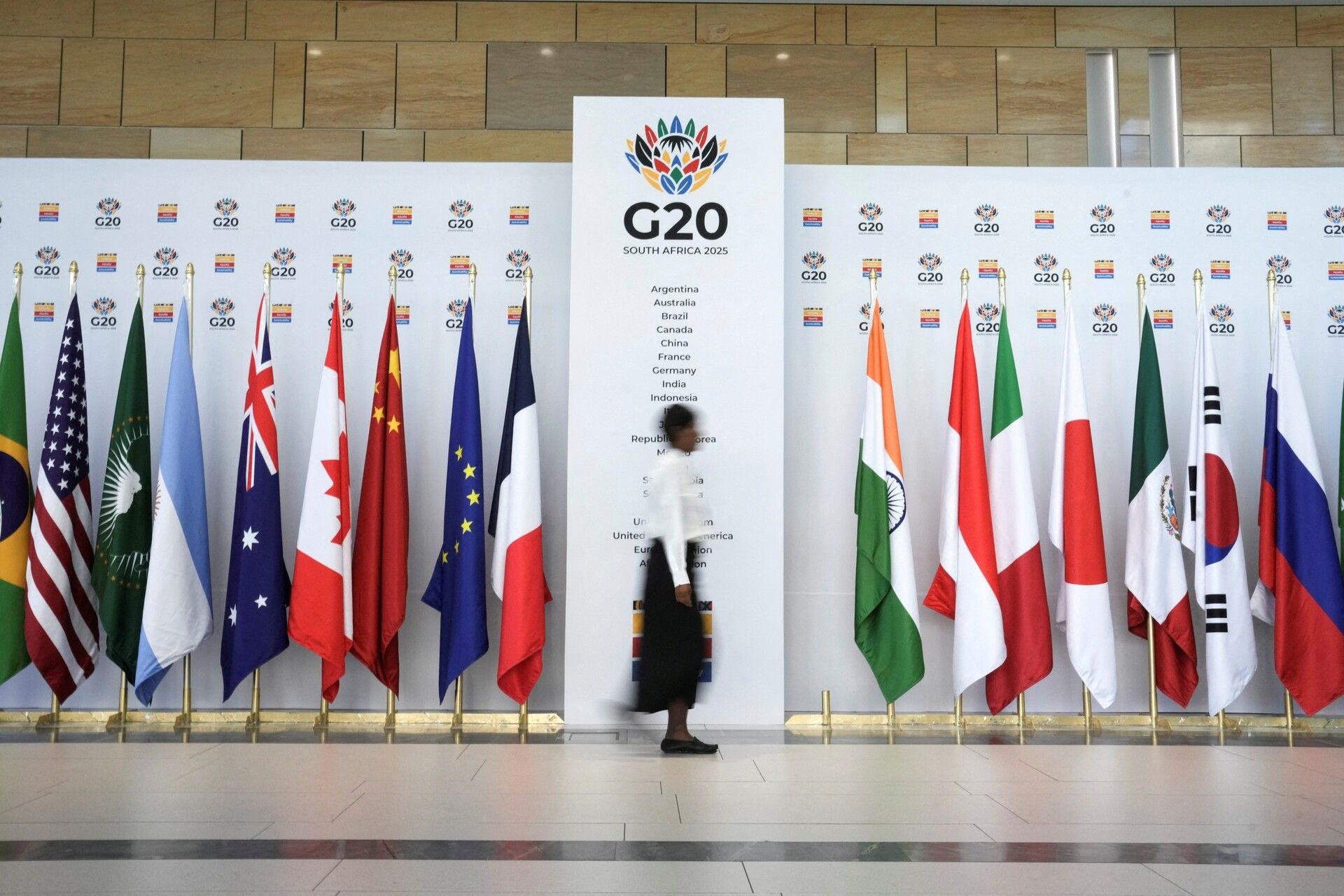
Image Source: ISPI
The G20’s coordinated push on AI governance is one of the strongest indicators that global harmonisation, or at least interoperability is possible. Their work linking AI governance to sustainable development reflects a maturing view: AI is not a siloed technology; it’s a cross-sector infrastructure.
The shift is significant: AI governance is no longer being framed as a technology issue but as a geopolitical and economic one.
But the challenge remains:
If every region invents its own risk taxonomy, audit standard, and reporting format, global AI markets will fragment.
Practical harmonisation starts with:
Shared risk categories
Mutual recognition of audits
Standardised incident reporting
Before the world can regulate AI globally, it must agree on the vocabulary. Interoperability is the first step, not the last.
The message is clear: global interoperability will matter more than national regulation. Fragmented governance will create fragmented AI markets, and fractured economies.
Interoperable governance is the only way global organisations will avoid technical debt, duplicated effort, and regulatory conflict.
ADOPTION OUTRUNS GOVERNANCE
The Global AI Governance Readiness Gap

Image Source: Institute For Law & AI
Nearly every major analysis this week highlights the same problem: organisations are adopting AI far faster than they are building governance capacity. According to the Atlantic Council’s governance review, the world is now facing a dangerous mismatch:
AI adoption is exponential
Governance maturity is linear
Regulatory sophistication is uneven
Talent pipelines cannot keep up
Cyber governance is lagging behind model complexity
This “readiness gap” is emerging as one of the biggest strategic risks of the next decade. Organisations are deploying AI faster than they are building internal governance controls, creating environments where:
unchecked model drift becomes common
shadow AI systems proliferate
non-compliance becomes invisible
cyber vulnerabilities multiply
risk lives inside models leadership can’t explain
No organisation can scale AI safely without a Minimum Viable Governance Stack:
A complete model registry
Mandatory risk classification
Transparent audit trails
Documented data lineage
An internal governance escalation map
Clear separation between experimentation and production
This isn’t optional. It’s baseline infrastructure.
In a world where AI accelerates faster than regulation, internal governance becomes a competitive advantage, and soon, a survival requirement. AI maturity without governance maturity is a systemic risk, and markets will eventually price that risk in.
Governance Is the New Global Competitive Advantage.
The next decade will not be defined by which countries have the best algorithms. It will be defined by which countries ,and organisations have the governance structures to deploy powerful AI responsibly, sustainably, and safely across borders. Countries and organisations that make governance a competitive advantage, not a compliance chore, will command trust, enable safer innovation, and unlock more stable markets.
AI leadership is shifting from capability to credibility.
We are moving from a world of principles to a world of practice; the leaders who win will be those who invest in people, instruments and interoperable systems.
Those who treat governance as a strategic investment will attract partners, win public trust, and unlock innovation at scale.
Those who treat it as a bureaucratic burden will struggle to keep pace with a world that is moving from principles to practice at unprecedented speed.
If your organisation had to publish its AI governance posture tomorrow, transparently, would you be proud of what it reveals, or exposed by what it lacks?
Don’t miss out on future updates, follow me on social media for the latest news, behind-the-scenes content, and more:
Threads: Click here
Facebook: Click here
Instagram: Click here
LinkedIn: Click here
Enjoyed this newsletter? Share it with friends and help us spread the word!
Until next time, happy reading!
JOIN THE COMMUNITY
The Bridging Worlds Book
Discover Bridging Worlds, a thought-provoking book on technology, leadership, and public service. Explore Lawrence’s insights on how technology is reshaping the landscape and the core principles of effective leadership in the digital age.
Order your copy today and explore the future of leadership and technology.
SHARE YOUR THOUGHTS
We value your feedback!
Your thoughts and opinions help us improve our newsletter. Please take a moment to let us know what you think.
How would you rate this newsletter? |
Reply